

Morning routines in coastal towns often blend together, but not in Byron Bay. Here, sustainability is operational: reusable cup norms, zero-waste cafés, barefoot commutes. Across this Australian town, environmental design aligns with daily life. Byron Bay’s appeal isn’t just its scenery, but its systems – visible in surf habits, local markets, and slow-footed travel. What follows is a guide to understanding that rhythm through practice, not posture.
What Makes Byron Bay’s Rhythm Uniquely Sustainable
Not every morning starts with motion. But in Byron Bay, the first light seems to trigger it. By 6:30 am, salt clings to bare ankles, and the air carries a blend of sea spray and oat milk. It’s not scenic, it’s structural.
Surfers trace the curve of The Pass before breakfast, boards tucked underarm like ritual tools. Others cycle barefoot to café windows, reusable cups already out. These aren’t gestures – they’re defaults. The town’s rhythm doesn’t reward performance, only repetition. It’s the repetition that tells you what matters.
Technically, this is behavioral sustainability, micro-practices that reduce impact through sheer frequency. Sociologists might define it as “habitual environmentalism.” But labels fray quickly here.
And yet, it’s not effortless. Look closely – the bins are clearly labeled, locals hesitate before tossing anything, and visitors pause, read, adjust. No signage yells. Still, systems speak. The signal is felt, in what’s absent as much as what’s offered.
Conscious Food and Zero–Waste Culture in the Bay
A single block can host three cafes – all offering oat, almond, macadamia milk by default. This isn’t choice inflation. It’s a local alignment. If the rhythm has flavor, Byron’s is nutty and compostable.
Behind Bay Lane, crates of produce arrive before 7 am, unloaded by hand. Labels are handwritten, paper-bound. The absence of plastic wraps feels conspicuous. But perhaps that’s the point. Aesthetic decisions? Possibly. But more likely – functional minimalism, shaped by constraint and care.
Here are a few anchors of the zero–waste ecosystem in Byron Bay:
- Refill-friendly spots for water and dry goods
- Markets with local produce and compostable packaging
- Cafes offering discounts for reusable cups
- Glass-return systems at beach bars
- Absence of single-use plastics in visible service areas
What appears casual is calibrated. Take the café window on Fletcher Street. A notice – “BYO only after 11” – isn’t scolding. It anticipates behavior, corrects gently. And people comply, not because they’re told to, but because they’re surrounded by people who already do.
This is what sustainability looks like when it stops advertising itself – when it retreats into the habitual and loses its novelty.
Slow Travel and Community-Integrated Stays
 Not every traveler slows down willingly. Some do it because the town invites slowness without insistence. Roads are short, shoulders wide, paths clear but unpaved. Byron Bay isn’t designed for haste. Or rather – it undoes haste.
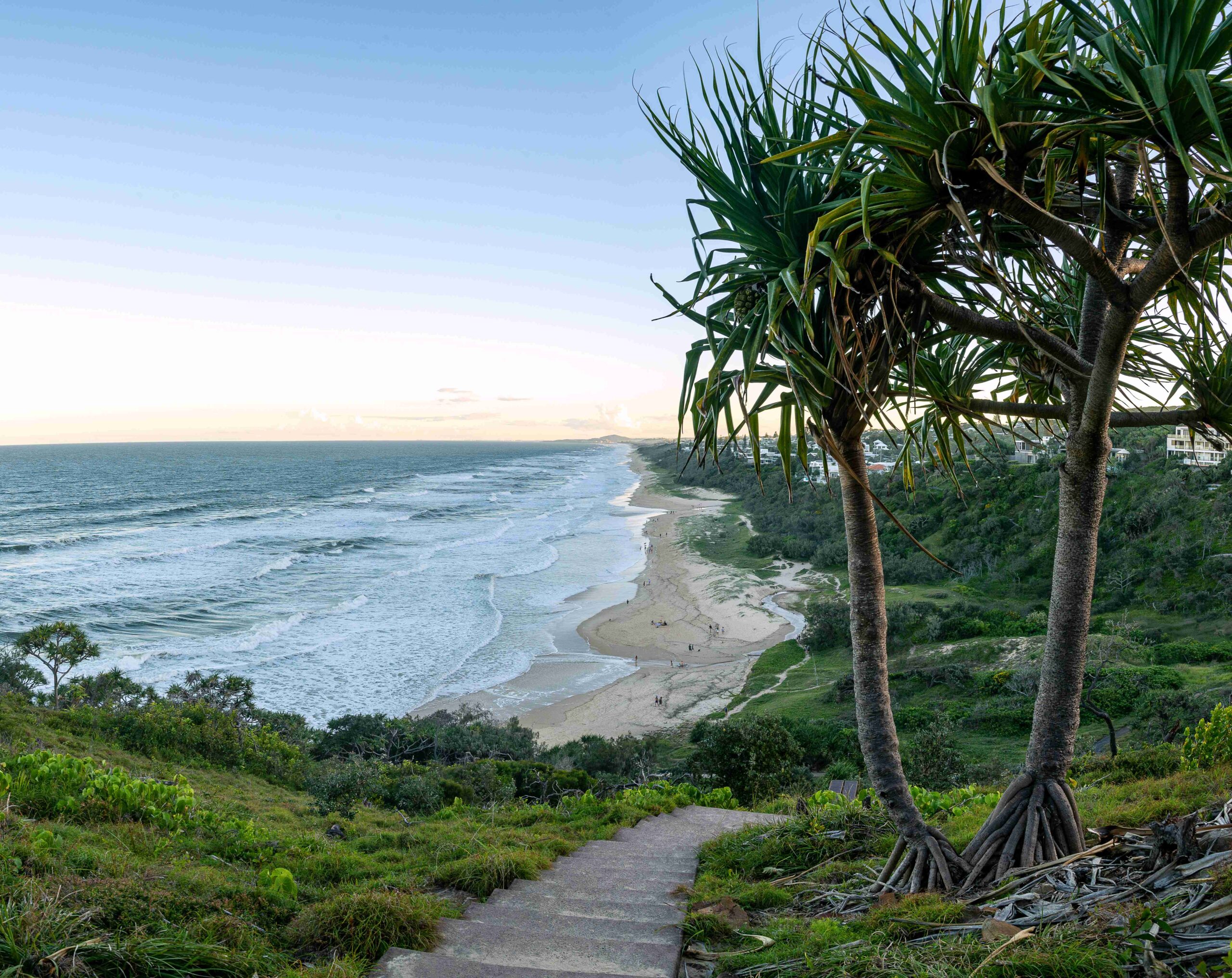
From Tallow Ridge, a walking track descends gradually into the coastal brush. There’s no signage except a carved stick at the fork. No arrows, just a suggestion. That’s enough. Locals know; visitors follow. And that’s the soft choreography of place-respect.
Many stayed here to avoid fanfare. Guesthouses post quiet hours but rarely enforce them. What matters more: shared kitchens, laundry hung at dusk, bikes left unlocked. It’s not about being rustic. It’s about staying porous, to air, to light, to neighborhood rhythm.
Some properties reject formal reception desks altogether. Keys are left in baskets; instructions arrive as poems. But beneath the informality is a rigor: greywater systems, rooftop solar, native plant buffers. It’s not off-grid – it’s interwoven.
And when people leave, they tend to walk. Or pedal. Or just linger, as if speed might break the spell.
Linking Byron to Broader Sustainable Travel in Australia
Byron Bay doesn’t try to be a hub. But it becomes one, through pattern rather than plan. Visitors who adapt to its slower rhythm often carry that sensibility further: up the coast, inland, or out to sea.
The logic isn’t geographic. It’s behavioral. Those who stay in Byron and absorb its mode of travel – light, local, conscious – tend to seek out similar ecosystems elsewhere.
Some start with a reef overnight, opting for immersive reefsleep options that emphasize minimal disturbance:
Review: Reefsleep, Great Barrier Reef
Others recalibrate their expectations of accommodation entirely, choosing eco properties where architecture disappears into the surroundings:
How to Tell if an Eco Hotel Is Legit
Even wildlife interactions take a turn, shifting toward patience, distance, and respect. The notorious “quokka selfie” becomes less about posing, more about coexistence:
How to Nail a Responsible Quokka Selfie
In that sense, Byron Bay isn’t just a destination. It’s a calibration tool. Visitors arrive with expectations – itineraries, lists, photos to recreate. Most leave with something else: a pace, a pause, a small shift in posture that lingers.
Or not. Some resist. Some scroll past it. But the town remains indifferent to the missed cue. Its rhythm continues, quietly, without insistence.